GLP-1 Weight Loss: Expect 8–12% Real World Loss; Protect Muscle
GLP-1 medications produce clinically meaningful weight loss for many eligible adults, typically in the range of 5% to 21% of starting body weight depending on the drug, dose, and duration. That effectiveness only holds under clinician supervision, since dosing, screening, and side effect management determine whether the benefit outweighs the risk. Candidates generally need a body mass index of 30 or higher, or 27 with a related health condition, and ongoing medical oversight throughout treatment. This is consistent with guidance from the National Institute of Diabetes and Digestive and Kidney Diseases.
TL;DR:
- Most weight loss on GLP-1 medications ranges from about 8% to 21% of initial body weight in real-world settings, with higher doses producing greater results.
- Eligibility requires a BMI of 30 or higher, or 27 with a related health condition, and treatment must be supervised by a healthcare provider to manage dosing and side effects.
- Common side effects include gastrointestinal symptoms like nausea and reflux, which usually improve over time, but serious risks such as pancreatitis and thyroid tumors require careful screening.
- Discontinuing GLP-1 therapy often leads to weight regain, emphasizing the importance of long-term management and ongoing medical oversight.
- Cost and insurance coverage significantly influence real-world outcomes, with long-term treatment generally recommended to sustain weight loss benefits.
Table of Contents
- How GLP-1 and Dual Incretin Drugs Cause Weight Loss
- How Much Weight Do People Actually Lose on GLP-1s?
- Who Is a Candidate, and What Rules Out Treatment?
- What Does Treatment Actually Look Like Month to Month?
- What Side Effects and Risks Should You Expect?
- How Do You Protect Muscle Mass While Losing Weight?
- What Does GLP-1 Treatment Cost, and What Happens Long Term?
- What Should You Ask a Clinician Before Starting?
- Beyond Weight Loss: Off-Label Use and Where Research Is Headed
- Does GLP-1 Efficacy Differ by Age, Sex, or Ethnicity?
- What Don’t We Know Yet About Long-Term Safety?
- How Does Treatment Affect Mental Health and Motivation?
- Why Diet and Exercise Still Matter With GLP-1 Therapy
- Hypergevity’s Approach to Clinician-Guided GLP-1 Care
- Ready to Start Your Own Evaluation?
- Sources
- FAQ
How GLP-1 and Dual Incretin Drugs Cause Weight Loss
GLP-1 stands for glucagon-like peptide-1, a hormone your gut releases after eating that tells your brain you’re full. GLP-1 receptor agonists mimic that hormone at doses far higher than your body produces naturally, and that’s the entire mechanism behind the appetite effect. The drugs act on receptors in the hypothalamus, the brain’s appetite-regulation center, dialing down hunger signals and food cravings well before you’ve eaten enough to feel physically full in the traditional sense.
At the same time, these medications slow gastric emptying. Food sits in the stomach longer, which extends the feeling of fullness after a meal and reduces how much you want to eat at the next one. This same mechanism explains most of the nausea, bloating, and reflux patients report early in treatment. Slower stomach emptying also affects how quickly other oral medications get absorbed, which is one reason clinicians review your full medication list before prescribing.
GLP-1 agonists also improve insulin secretion and suppress glucagon release when blood sugar is elevated, which is why the drug class started as a diabetes treatment before its weight effects became the bigger clinical story. Better insulin sensitivity indirectly supports weight loss by reducing the swings in blood sugar that often drive hunger and snacking.
The newer generation of therapies adds a second hormone receptor into the mix: GIP, or glucose-dependent insulinotropic polypeptide. Drugs that activate both GLP-1 and GIP receptors appear to produce a larger effect on appetite and energy balance than GLP-1 alone, likely through complementary actions on fat metabolism and additional satiety signaling in the brain. That dual-agonist mechanism is a major reason tirzepatide often outperforms semaglutide in head-to-head weight outcomes, though it also means dual agonists tend to carry a similar, sometimes slightly more pronounced, GI side-effect profile. You can find a deeper breakdown of how these mechanisms differ between drug classes if you want the full pharmacology.
How Much Weight Do People Actually Lose on GLP-1s?
A 2025 systematic review of 47 randomized trials covering more than 23,000 participants found GLP-1 receptor agonists reduced body weight by a mean of 4.57 kg compared to placebo, along with a 2.07 kg/m² drop in BMI and a 4.55 cm reduction in waist circumference. Those pooled numbers understate what individual drugs at approved obesity doses can do, since the review folds together lower-dose diabetes formulations with high-dose weight-management versions and a wide range of study populations.
The semaglutide-specific STEP trial program tells a more targeted story. Across its various obesity populations, semaglutide produced weight loss ranging from roughly 10.9% to 14.9% of body weight at approved doses, according to clinical resources summarizing the trial data, with benefits sustained as long as treatment continued.
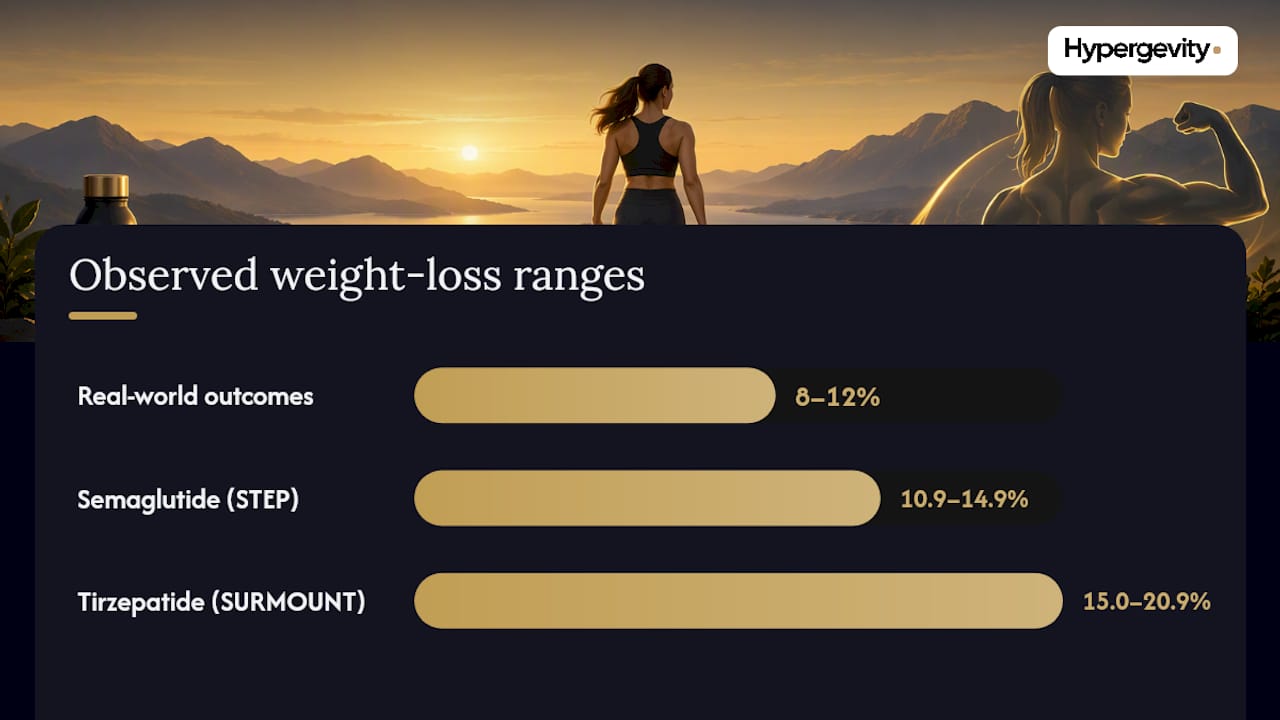
Tirzepatide, the dual GLP-1/GIP agonist, pushed those numbers higher in its own registration trials. The SURMOUNT program published in the New England Journal of Medicine reported dose-dependent mean weight loss at 72 weeks of 15.0%, 19.5%, and 20.9% at ascending doses. That dose-response pattern is one of the clearest findings in the entire GLP-1 literature: higher doses consistently produced more weight loss, though also more GI side effects, which is exactly why dose escalation is gradual rather than immediate.
Here’s the caveat that matters most for anyone reading trial data and planning their own outcome: real-world results tend to run lower than trial results. Evidence reviewed in a PMC analysis of GLP-1 outcomes found real-world weight loss often lands closer to 8% to 12%, a gap driven by inconsistent adherence, dose interruptions, insurance-related delays, and the fact that clinical trial participants get more frequent monitoring and support than the average patient managing treatment on their own. That gap is an argument for structured follow-up, not a reason to expect less from the medication itself.
| Drug class | Typical trial-reported weight loss | Key trial |
|---|---|---|
| GLP-1 agonists (pooled, mixed doses) | 4.57 kg mean vs. placebo | 2025 systematic review |
| Semaglutide (obesity dose) | 10.9% to 14.9% of body weight | STEP program |
| Tirzepatide (dual GIP/GLP-1) | 15.0% to 20.9% of body weight, dose dependent | SURMOUNT / NEJM |
If you’re weighing semaglutide against tirzepatide specifically, the pharmacologic comparison between the two goes deeper into why the dual-agonist mechanism tends to edge out single-pathway drugs on average, even though individual response still varies considerably.
Who Is a Candidate, and What Rules Out Treatment?
Eligibility for GLP-1 therapy follows a straightforward threshold. According to NIDDK guidance, FDA-approved weight-management medications are generally appropriate for adults with a BMI of 30 or higher, or a BMI of 27 or higher combined with a weight-related condition such as type 2 diabetes, hypertension, or obstructive sleep apnea. Medications are meant to work alongside a reduced-calorie eating plan and increased physical activity, not replace them.
Several contraindications rule treatment out entirely. Pregnancy is an absolute contraindication, since these drugs have not been established as safe for a developing fetus. A personal or family history of medullary thyroid carcinoma or multiple endocrine neoplasia syndrome type 2 (MEN2) also disqualifies most candidates, tied to a thyroid tumor signal observed in rodent studies. A history of pancreatitis is another red flag clinicians screen for closely, since GLP-1 drugs carry a rare but real association with pancreatic inflammation.
Beyond the hard stops, a competent clinical evaluation checks several practical details before writing a prescription:
- Current medications, especially insulin or sulfonylureas, which may need dose adjustments to avoid low blood sugar
- Gallbladder history, since rapid weight loss itself raises gallstone risk independent of the drug
- Upcoming surgery requiring general anesthesia, because delayed gastric emptying affects aspiration risk
- Diabetes status and current A1C, which shapes both dosing strategy and monitoring frequency
- History of disordered eating, which changes how appropriate appetite suppression is as a treatment tool
None of this is meant to gatekeep treatment unnecessarily. It’s meant to make sure the medication fits your specific health picture before you start.
What Does Treatment Actually Look Like Month to Month?
Treatment starts with a clinical assessment: your weight history, prior diet and exercise attempts, current medications, and relevant labs when your history calls for them. Baseline measurements give your clinician something concrete to compare against later, which matters more than it sounds like it would once you’re several months in and trying to judge whether the medication is working.
Dosing follows a slow escalation schedule, almost always increasing every four weeks rather than jumping straight to a target dose. That pacing exists specifically to manage tolerability. According to NIDDK’s clinical guidance on incorporating these medications into care, gradual titration paired with regular monitoring of weight and side effects is standard practice, with dose adjustment or discontinuation considered whenever risks start to outweigh benefits.
Expect a general timing pattern, though individual variation is real. Early weeks often bring the most noticeable appetite suppression and, for many, the most GI discomfort. Stanford Medicine clinicians report that weight loss commonly starts slowing around months 4 to 6, with a more complete plateau typically arriving around 12 to 18 months. The appetite effect shows up early; the total weight outcome unfolds slowly. That distinction shapes realistic expectations more than almost anything else in this process.
If you want a closer look at what the first stretch of treatment feels like day to day, a month-by-month breakdown of early treatment covers the practical adjustment period in more detail.
What Side Effects and Risks Should You Expect?
Gastrointestinal effects are, by far, the most common complaint. Nausea, constipation, diarrhea, and reflux affect a meaningful share of patients, particularly during dose increases, and Harvard Health’s review of GLP-1 side effects notes these symptoms usually ease as the body adjusts to a given dose. Eating smaller meals, avoiding high-fat foods during dose changes, and staying ahead of hydration all help. Clinicians sometimes recommend pausing a dose increase for an extra cycle if side effects aren’t settling, rather than pushing forward on schedule regardless.
The more serious, less common risks deserve straightforward attention rather than alarm. Acute pancreatitis is a documented, though uncommon, risk that warrants immediate medical attention if severe abdominal pain develops. Gallbladder disease, including gallstones, occurs more often during any rapid weight loss, GLP-1 driven or not. The thyroid tumor signal observed in animal studies is why clinicians screen for personal or family medullary thyroid cancer history before prescribing, even though this risk hasn’t been confirmed in humans at prescribed doses.
Drug interactions matter most with insulin and sulfonylureas, where combined use raises hypoglycemia risk and often requires dose adjustments to the diabetes medication. Pregnancy remains an automatic stop.
What happens when treatment ends is one of the best-documented findings in this field: weight regain is common and often substantial once the medication stops, since the underlying appetite signaling reverts without ongoing receptor activation. That’s the strongest argument for treating GLP-1 therapy as a long-term commitment rather than a short course. For a full rundown of what to expect and how side effects are typically managed, see Hypergevity’s guide to common GLP-1 side effects.
How Do You Protect Muscle Mass While Losing Weight?
Rapid weight loss without deliberate strategy tends to take muscle along with fat, and appetite suppression makes that risk worse, not better, because eating enough protein gets harder exactly when your body needs it most. A practical starting target for moderately active adults is roughly 1.0 to 1.5 grams of protein per kilogram of body weight daily, adjusted for kidney function, age, and other health conditions your clinician should weigh in on.
In practice, that often means front-loading protein early in the day when appetite is highest, rather than saving it for dinner when suppression has kicked in fully. Smaller, protein-forward meals spaced through the day tend to work better than trying to eat one large meal that appetite suppression makes difficult to finish.
Resistance training two to three times weekly gives your body a reason to hold onto the muscle it has, even in a calorie deficit. It doesn’t need to be elaborate. Bodyweight strength work or light resistance bands are enough to send the right signal if gym access or energy is limited early in treatment.

Reduced appetite can mask a genuine risk of under-eating, particularly around hydration, electrolytes, and micronutrients. Dietitian input is worth requesting for anyone losing weight quickly or managing other health conditions alongside treatment. A more detailed guide to protecting lean mass walks through specific meal timing and training strategies for this exact stage of treatment.
What Does GLP-1 Treatment Cost, and What Happens Long Term?
Cost and insurance coverage vary widely, and that variability shapes outcomes more than most people expect going in. Coverage gaps, prior authorization hurdles, and formulary changes cause a lot of the treatment interruptions that show up in real-world data as lower weight loss than trials report. A medication that works well but gets interrupted every few months rarely delivers its full potential.
The long-term implications of stopping are significant. Weight regain after discontinuation is well documented, which is why the NIDDK frames obesity medication as chronic disease treatment rather than a fixed-length course, similar to how blood pressure or cholesterol medications are managed indefinitely rather than stopped once numbers improve.
If cost or access becomes a barrier partway through treatment, the honest move is raising it directly with your clinician rather than quietly stopping. Options sometimes include adjusting dose, switching formulations, or exploring oral semaglutide as a needle-free alternative with different pricing dynamics. Planning for years, not months, from the outset avoids the whiplash of starting, stopping, and regaining that undermines most of the benefit.
What Should You Ask a Clinician Before Starting?
Choosing a path starts with a clear-eyed conversation, not a decision made from a drug name you saw online. A useful checklist to bring into that first conversation:
- What weight loss percentage is realistic for my specific health profile, not just the trial average?
- How will tolerability be managed if I have side effects during dose escalation?
- What does the monitoring schedule look like, and how often will we check in?
- What’s the plan if I need to pause or stop treatment, and what should I expect afterward?
- At what point would you refer me to obesity medicine specialty care or a bariatric surgery evaluation?
Referral to specialty care or surgical evaluation typically comes up when BMI is significantly elevated, when medical therapy alone hasn’t achieved meaningful results after an adequate trial period, or when comorbidities are severe enough to need a more aggressive intervention timeline.
Certain red flags should prompt an immediate re-evaluation rather than waiting for the next scheduled visit: severe abdominal pain, signs of gallbladder disease, unexplained rapid weight loss beyond expected ranges, or side effects that aren’t improving despite dose adjustments. Any of those warrants a call to your clinician, not a wait-and-see approach.
Beyond Weight Loss: Off-Label Use and Where Research Is Headed
GLP-1 and dual-agonist drugs are under active investigation for uses well beyond obesity and type 2 diabetes. Cardiovascular risk reduction is the most clinically advanced of these, with several agents already carrying label expansions or strong trial signals for reducing major cardiac events in high-risk patients independent of weight loss itself.
Research is also probing GLP-1 effects on fatty liver disease, chronic kidney disease, and even certain addictive behaviors, based on the theory that the same brain circuitry governing food reward may overlap with circuitry involved in alcohol and nicotine cravings. None of these applications are settled science, and off-label prescribing for anything beyond approved indications should happen only with a clinician who understands the current evidence and its limits.
The drug development pipeline is moving quickly too. Oral formulations, triple-hormone agonists that add glucagon receptor activity to the GLP-1/GIP combination, and longer-acting versions requiring less frequent dosing are all in active trials. Each new mechanism raises the same open question: does adding more hormonal pathways continue improving efficacy, or does it simply add more GI burden without proportional benefit? That’s still being worked out in ongoing research, not settled fact.
Does GLP-1 Efficacy Differ by Age, Sex, or Ethnicity?
Trial data shows GLP-1 response isn’t uniform across every demographic, and understanding that variation matters for setting realistic personal expectations. Older adults sometimes see attenuated weight loss compared to younger trial participants, partly due to differences in baseline metabolic rate and partly due to more conservative dose escalation when other health conditions are present.
Sex differences show up too. Some trial subgroup analyses suggest women may experience somewhat greater percentage weight loss than men on average, though absolute differences vary by study and are not consistent enough across the literature to treat as a firm rule for any individual patient.
Ethnic and racial representation in the major registration trials has historically been imperfect, with some populations underrepresented relative to their share of people affected by obesity. That gap matters because genetic variation in receptor sensitivity and metabolic response could plausibly affect outcomes, and the field is still catching up on data robust enough to draw firm conclusions across every group. The honest takeaway is that individual response varies more than any demographic category predicts on its own, which is exactly why personalized monitoring, rather than a one-size-fits-all dosing script, matters throughout treatment.
What Don’t We Know Yet About Long-Term Safety?
The trials that established GLP-1 efficacy mostly ran 68 to 72 weeks, roughly a year and a half. That’s long enough to establish short and medium-term safety and the shape of the weight-loss curve, but it’s not long enough to fully answer questions about use spanning five, ten, or twenty years, which is the reality for most people who start this medication expecting to stay on it long term.
Open questions that longer-term data will eventually need to answer include whether extended appetite suppression carries any nutritional or bone-density consequences over a decade of use, whether the thyroid signal observed in animal studies has any human relevance at extended exposure durations, and how outcomes hold up as patients age into different comorbidity profiles while remaining on treatment.
Postmarketing surveillance and longer observational cohorts are actively filling in these gaps as the drugs remain on the market longer, but no dataset yet spans the multi-decade timeframe that would fully answer every long-term safety question. That’s not a reason to avoid treatment. It’s a reason ongoing monitoring with your clinician matters just as much in year three as it does in month three, and why any responsible treatment plan builds in regular check-ins rather than a “start and forget” approach.
How Does Treatment Affect Mental Health and Motivation?
Weight loss carries psychological weight of its own, and GLP-1 treatment changes that experience in ways worth naming directly. Many patients describe a genuine relief in finally quieting persistent food thoughts that talk therapy or willpower alone never touched, which can be validating after years of being told weight was simply a discipline problem.
That relief has a flip side. Rapid changes in eating patterns and body image can surface complicated emotions, particularly for anyone with a prior history of disordered eating, where appetite suppression intersects uncomfortably with old patterns. Identity shifts tied to a changing body, plus adjusting to a fundamentally different relationship with food and hunger cues, are real adjustments that deserve support rather than dismissal as side issues.
Clinicians increasingly recommend pairing medication with some form of behavioral support, whether that’s a structured program, a therapist familiar with eating behavior, or simply a more attentive follow-up schedule that leaves room for these conversations rather than treating each visit as a weigh-in and dose check. Sustainable results tend to track with patients who feel supported through the adjustment, not just medicated through it.
Why Diet and Exercise Still Matter With GLP-1 Therapy
GLP-1 medication and lifestyle change aren’t competing strategies. They’re synergistic ones, and the trials themselves prove it: every major registration study paired the medication with structured diet and activity counseling, not medication alone. The drug handles the appetite side of the equation; nutrition quality and movement determine what that reduced appetite gets spent on.
A lower-calorie eating pattern built around adequate protein and fiber works better with these drugs than an unstructured “eat less of everything” approach, because appetite suppression already limits volume. What you choose to eat within that smaller volume determines whether you’re maintaining nutrient adequacy or slowly running a deficit in something your body needs.
Physical activity compounds the benefit beyond muscle preservation. Regular movement supports the same insulin sensitivity improvements the medication is already driving, and it gives patients something to actively work toward beyond a number on a scale, which matters for staying engaged with treatment over the long timeline these drugs require.
Hypergevity’s Approach to Clinician-Guided GLP-1 Care
Effective GLP-1 treatment depends on the same fundamentals throughout this piece: real clinical assessment, careful dose escalation, and honest monitoring, not just a prescription and a shipping label. A clinician-guided weight-management program typically involves licensed providers who evaluate eligibility case by case, with flat pricing and direct-to-door delivery replacing the friction of traditional insurance-gated access. Patients get ongoing provider support and practical education on what to expect at each stage, including lean-mass preservation guidance during active weight loss. The right move for anyone weighing this option is a real conversation with a clinician about your specific health profile, not a decision made from a trial statistic alone.
— Hypergevity
Ready to Start Your Own Evaluation?
Everything in this article points to the same conclusion: GLP-1 treatment works best as clinician-guided, ongoing care, not a one-time prescription filled and forgotten. Hypergevity’s Medical Weight Loss program is built around that model, starting at $199 per month, with licensed U.S. providers handling intake, eligibility screening, and dose planning from the first visit.

If semaglutide fits your clinical picture, it’s available through Hypergevity at $199 per month, and tirzepatide is available at $249 per month for patients whose evaluation points toward the dual-agonist option. Every prescription starts with a real clinical evaluation, discreet delivery, and ongoing follow-up rather than a set-it-and-forget-it shipment. Eligibility and dosing depend entirely on your individual health history, which is exactly why the process starts with a provider conversation rather than a checkout page. If you’re ready to find out where you stand, start your evaluation with Hypergevity and get a clinician’s read on the option that actually fits your health profile.
This article is general information, not a substitute for advice from a qualified doctor. Consult a qualified healthcare professional about your own circumstances before acting on anything here.
Sources
- Systematic review, 2025 (PubMed)
- Tirzepatide Once Weekly for the Treatment of Obesity | NEJM
- Prescription Medications to Treat Overweight & Obesity - NIDDK
- GLP-1s 101: What the science says about weight loss, side effects, safety - Stanford Medicine
FAQ
Which GLP-1 Works Best for Weight Loss?
Tirzepatide, the dual GLP-1/GIP agonist, produced the largest average weight loss in registration trials, reaching up to 20.9% of body weight at the highest dose. “Best” still depends on your tolerability, health history, and access, since semaglutide remains highly effective and better suited for some patients based on side-effect response.
What Are the Downsides of GLP-1 Medications?
The most common downsides are gastrointestinal: nausea, constipation, and reflux, especially during dose increases. Less common but more serious risks include pancreatitis, gallbladder disease, and a thyroid tumor signal that rules out candidates with a personal or family history of medullary thyroid cancer.
How Many Pounds per Month Can You Lose on GLP-1?
Weight loss isn’t linear and varies by drug, dose, and individual response, but most people see the fastest losses in the first few months before the rate slows around months 4 to 6. Total losses across a full treatment course commonly range from 8% to 21% of starting body weight depending on the specific medication and how closely treatment is followed.
Who Cannot Take GLP-1 Medications?
People who are pregnant, have a personal or family history of medullary thyroid cancer or MEN2 syndrome, or have a history of pancreatitis are generally excluded from treatment. A full medical history review, including current medications and gallbladder history, is a standard part of clinical eligibility screening before any prescription is written.
Does Hypergevity Offer GLP-1 Weight Loss Treatment?
Yes. Hypergevity offers Medical Weight Loss starting at $199 per month, with semaglutide available at $199 per month and tirzepatide at $249 per month through licensed U.S. providers. Every plan includes a clinical evaluation, dose planning, and direct-to-door medication delivery.